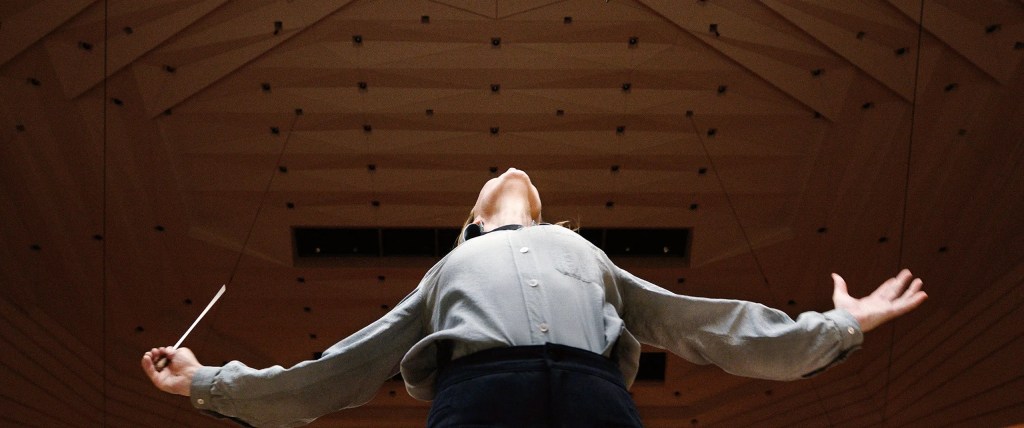
Symphonies and Sex: Natalie Murray-Beale on being a woman in the classical music industry
By Freja Newman
31 May, 2023
The recent film, Tár (2022), directed by Todd Field, follows the rise and fall of self-built and musically renowned, Lydia Tár; an ambitious, talented, famous, and completely fictional character, played by Cate Blanchett. In one scene – often referred to as the Juilliard masterclass scene – Blanchett performs for ten minutes, without cutting, in one singular camera take. The scene invites audiences to consider what it means to truly separate the artistry from the artist. Tár engages her students in a debate about the relevance of J.S. Bach’s music today. She paces the auditorium and rapports back and forth with students’ oppositions, both verbally and musically by playing his work on the piano.
“In Bach, the question is always more interesting than the answer,” she says.
Behind this scene was Natalie Murray-Beale holding her breath.
Natalie is a music consultant and conducting supervisor. She was brought onto the set of Tár as a coach to Blanchett. She was initially tasked with supporting her as she learnt how to conduct an orchestra. She aided Blanchett with her piano playing, specifically with the character’s leadership position in mind, and advised Blanchett on what it meant to play an orchestral reduction on the piano.
“I don’t think it was by chance that Cate chose to work with a woman,” Natalie said. “In fact, throughout the entire process of the film, she brought several women on board to support the process and the film itself.”
However, this coaching role eventually grew into more as Field and the production company asked Natalie to be on set for all the music scenes that were played.
“I would advise the props department on very specific things like pencils, batons, bags, how the scores would be bound and what type of edition Blanchett’s character would use in the orchestra,” Natalie described. “I was there to answer any music specific questions that any department had along the way, but most of all, I was there to support Cate in crafting and conducting the piano scenes.”
She was on set that day when this masterclass scene was being filmed.
“It was a beautiful, intense day,” Natalie said, “and really masterful performing.” However, the core technical element that underpinned the entire performance – the choice to have it shot in one camera take – only heightened the expectations for a scene that was already bursting at the seams. Apparently, the first take was really extraordinary, however, the camera crew ran into problems at the very end, just for the final 30 seconds. To this day, nobody on set knows if the take counted, or if they were just part of the lucky few to witness it.
As a conductor and musician, this ten minute long scene took on an extra layer of meaning.
“It was interesting for me because when actually playing Bach, there’s a certain expectation,” Natalie noted. “I’m sure Cate sensed that, as did everyone else. What she was doing felt quite close to, sometimes, the same feeling with certain performances I’ve entered into.”
Natalie was born and grew up in the Mid North Coast region of New South Wales. She is the second-youngest out of five girls and she has always felt connected to music. I’ve had the privilege to speak to Natalie multiple times across the years. One of my favourite conversations of ours took place at the end of 2020 after she had just completed her Royal Opera House debut in Covent Garden. It was a collaboration with stage director Katie Mitchell on the multi-media construction, “A New Dark Age”. I remember her describing the space so vividly; the red velvet seats and intricate gold designs embellishing the roof, walls, and stage. During the performance, Natalie conducted three incredible female opera singers perform music by Missy Mazzoli, Anna Meredith and Anna Thorvaldsdottir – three leading female composers – as a film by Grant Gee was projected behind them. It was a sombre, yet powerful performance; a spiritual ode to the pandemic and its woes. Natalie was the ninth woman to conduct on the main stage of the Royal Opera House.
While she currently lives abroad in Kennington, London, right now she is in New Zealand, rehearsing and conducting repertoire with orchestras in cities across the country. During her small stopover in Sydney before her work began, I was lucky enough to sit down with her over a pot of black tea; a staple for her since her move to London over two decades ago. We spoke late into the afternoon as she exchanged countless stories and musings on her adolescence and aspirations.
“I admired many musicians growing up and I used to really cherish the moment when I’d have enough pocket money to go and buy a CD at the time,” Natalie said, smiling as she remembered. “One of the labels was Deutsche Grammophon, which was this hugely prestigious classical music label, and I do remember my first Deutsche Grammophon disc that I bought myself. It was a very big moment.”
In her country-town primary school, Wingham Catholic Primary, her piano teacher, Sister Gonzales, was a source of great encouragement for Natalie, constantly believing in her passion and pushing her to nurture the talent she possessed. As she went on to study at the Sydney Conservatorium of Music, she found her passion for music ignited in a different way through conducting.
“I came into the industry first as a pianist, working with conductors very closely in preparing opera,” she said. “It was through my initial jobs that I started to gain more experience with conducting and with creating and leading large productions.” From that point onwards, she did more training and assisted some very high profile conductors who allowed her to learn and gave her time for immense growth and valuable opportunities.
Near the end of her studies in Sydney, others were noticing this passion too. So many that she was selected to study at the Guildhall School of Music and Drama in London; a prestigious music school located in the heart of the City of London. From this moment, Natalie knew her life was about to change. She knew she would have exposure to an immense amount of great musicians and visit great concert halls and opera houses.
However, Natalie’s journey wasn’t without its discouragements and opposition.
“Of course there were also people discouraging me from pursuing a certain career,” she said. “I think that the job of a conductor is an immense one, a challenging one. There aren’t many positions available and people know how much it requires of you personally.”
For her, as a woman, she knew there would also be an extra layer of difficulty.
“There are many incredible, passionate, and talented women in classical music today,” Natalie said. “However, what is still apparent is that the most powerful, highest status jobs are generally not held by women.” For Natalie, what was meaningful about Tár was seeing the idea of a woman in one of the top jobs in the world for the conducting industry normalised. The film was infused with biopic elements, painting Tár’s life as a reality. While Lydia’s character was extremely complex and controversial, she also spoke to the nuance of power and gender in the classical music profession. She embodies, as Susie Orbach describes, “a generational ambition” for women. It showcased the struggle in projecting fearlessness and fierce passion and maintaining vulnerability.
“It was very important to me to see a female lead character represented, and that character being a female conductor,” Natalie said. She described how she could relate to the amount of care and preparation audiences see Tár putting into her work, as well as the elements of travelling for work, the great moments of the first rehearsal with an orchestra, and the need for quiet and escape away from the music making in rehearsals.
“It’s shown as almost obsessive…and the constant moving that the character experiences felt very real to me,” Natalie said. “I think you can witness, stamina-wise, what it takes out of her to conduct both physically and mentally.”
In the 2021 MIDiA ‘Be the Change: Women Making Music’ survey, results revealed that the “main challenge for women in the industry was sexual harassment, followed by misogyny, male dominance and women finding it harder to gain recognition than men.”
A more recent 2022 study conducted by the Donne Foundation looked at the gender and diversity disparity for the 2021-2022 classical music season, focusing on 111 orchestras across 31 countries. 20,400 compositions were lined up, and only 7.7% were written by women, most of them white (5.5%). The world of classical music still has a long way to go.
Recent conversations with a current third-year student from the Sydney Conservatorium (or ‘the Con’) only proved how much these statistics were indeed a reality. Elizabeth Ring, a cellist, is completing a Bachelor of Music (Performance) in the cello and caught up with me over a glass of wine at the Library Bar in Sydney’s CBD.
“You can definitely notice the divide,” Ring said. “No matter how good you are, there seems to be this unspoken scepticism of women conductors or performers holding powerful posts, whether my guy friends mean to give off that energy or not.”
However, what seemed to drive these women amidst these obstacles was a passion and love for music that was too deep to ignore. For Natalie, being related to Les Murray, a leading Australian poet with over 30 volumes of published work, meant a great deal to her. Les was her father’s cousin. She still remembers reading and studying his poems at school and holds that memory close to her, even today. Particularly growing up in a small town far away from the city, Natalie was immensely aware of the fact that there was a practicing artist in her family; someone that really dedicated their life to art and creativity.
“He was a huge inspiration for me and proved to me that anybody could be an artist,” she said. “He showed me, growing up, that you didn’t need to come from a prestigious family or even have great access to other art and culture. It could just come from within you.”
One of Natalie’s first memories of conducting that really stood with her took place during a masterclass in Amsterdam. She was conducting Debussy’s Prelude to the afternoon of a fawn. She wasn’t conducting a particularly large orchestra or working in an expansive auditorium. During the performance, she described how it sounded exactly how she had imagined and hoped. However, it was a small moment after she finished conducting that made the experience stand out.
“After conducting, the woodwind players came up to me and said ‘your tempo, your speed, it was so easy to play!’,” Natalie said, excitedly re-enacting their encounter. “It was just wonderful to hear and at that moment, I think it gave me a lot of confidence.”
Lydia Tár isn’t real. However, Natalie Murray-Beale is.
She is a conductor, she is a woman, and she dreams of younger generations gaining exposure to more female leaders and people from all backgrounds making music, managing artistic companies, and creating opportunities in the music industry.
“I think we’re all acutely aware of the challenges that face us,” she said. “I really, really hope that people from all over continue to have an appetite for live music making, for gathering together in big groups and experiencing music together.”
##
 Freja Newman