
The Monster, The Muse
By Freja Newman
1 May, 2024
To be in and represent a female body in the early twenty-first century is to explore the beautiful and discarded, and tell one’s story through new forms.
You’ve seen immortality before, remember? It surrounds you in the form of a woman. You’ve seen her face as acrylic or oil on canvas, in bronze that rusts or stone that chips. You tested her gaze and it returned when she caught yours, eyes moving as you passed. She was a monument, remember? An attraction and marvel; unique and easily obtained for a camera to be shared and repurposed. She existed only as words in a book and you remembered her by the phrases curated by another’s imagination. She had a name that rhymed and a life easily summarised into lyrics and chords. You’ve forgotten the name of the song. You focus for a moment and she’s there, on your screen, a billboard, a cover.
She’s a muse that perhaps consented to the portrait but not the immortality, and she’s not alone.
Countless women have been eternalised and remembered as muses rather than themselves throughout European history—for appearing rather than acting. Beauty, competition, vanity, innocence, judgement, possession, and submission are immortalised into a spectacle for so-called femininity to be surveyed. This has bred an assumption and an inheritance of performance. In Ways of Seeing, John Berger notes how “from the earliest childhood”, women are “taught and persuaded to survey [themselves] continually”; to watch themselves being watched and respond accordingly. It doesn’t take a man on the street or behind an easel to prompt us to perform. It’s an instinct fed to women for the purpose of survival.
To escape this constant objectification and change the way sight is projected onto them, women have made muses of themselves. Female artists, writers, activists, and innovators have left behind a fragmentation—an assortment of self-portraits, retellings, autobiographies, performances, and footprints slammed onto paths they weren’t allowed to tread. Paths that still exist today for us to pass through.
According to Lauren Elkin, to reframe their immortality, the muse had to become a monster. Monstrosity represents all a society repulses and ejects. As the borders of normality are built, all that is deemed ‘monstrous’ is cut off and forced to dwell at this boundary. Monstrosity is therefore defined by “difference and excess.” To be in and represent a female body in the early twenty-first century is to explore the beautiful and discarded, and tell one’s story through new forms. In her book, Art Monsters: Unruly Bodies in Feminist Art, Elkin writes that “to become the artists” and “paint [themselves] into the picture”, women have to “remake the picture entirely, [find] a new language, cut it all to pieces, instigate processes of entropy, de-create to create.”
Ana Mendieta (1948-1985) de-creates through her photographically documented performance, Untitled (Glass on Body Imprints). In a series of thirty-six slides, she presses a sheet of glass against her face and naked body. Her bodily features, up close and deformed by the sheet, demand attention. She alienates us through her body’s indecipherability, asserting discomfort in a reimagining of the ‘grotesque’. She flattens and obliterates her body, disrupting how others perceive and draw conclusions about her race, gender, age, and class. The movement and transition of her face is disturbed by the violence of the viewer’s gaze. Through this, Mendieta arms herself with the aesthetic lens of abjection as a “politicised strategy”, according to Leticia Alvarado, unsettling her audiences. Deformity, here, is her weapon, as she comments on the societal biases she endured as a Cuban-American female artist. Through a series of thirteen vignettes, rather than one portrait, she not only protests gendered violence, but also the process of racialisation in the United States. Through this performance, she hybridises her identity, grounding her representation of self in intersectionality. In her introductory essay from the catalogue of her 1980 exhibition, Dialectics of Isolation: An Exhibition of Third World Women Artists of the United States, Mendieta writes that “as non-white women our struggles are two-fold. This exhibition points not necessarily to the injustice or incapacity of a society that has not been willing to include us, but more towards a personal will to continue being ‘other.’”
Cindy Sherman also reimagines the self-portrait by becoming both the subject and artist. She harnesses her body as a canvas for costume and make-up, transforming herself into figures and styles stretching the Baroque period with characters like Bacchus, the Roman wine god, to the 21st century Real Housewives of Beverly Hills. She exposes stereotypes through artifice, particularly focusing on gender and class identity. Through saturation and exposure, Sherman presents perception as something mediated by images that cannot necessarily be trusted. Photographs are a product of the person behind the lens, and therefore can easily manipulate and mislead.
While women are told to take up less space and draw less attention, they are simultaneously objectified into the role of the eternal subject, hung on a wall or a pedestal for others to gawk at. However, this doesn’t mean women never gazed back or tried to reinvent what it means to see. Voice was and still is used by women to make themselves material and assert themselves into a space that preferred apologies or silence. American installation artist Ann Hamilton demonstrated this tendency by asking her class of mostly young women to carry around a 4 x 8 sheet of plywood with them for a week so they could “get used to taking up more space”. On public transport, they found themselves crammed between strangers’ bodies and a material that belonged to walls. It followed them home and to class. They had to live with the scale of the space they took up at every moment. While many found themselves apologising in these moments, after a while, they also resented the need for politeness. These reactions allowed Hamilton to illustrate how art is social and a lived process that enters every aspect of one’s life. The art of installation is about creating spaces and environments that respond to a system. One must walk into the piece to prove its existence. Similarly, a woman must speak to ensure her existence isn’t ignored.
Elkin speaks to this idea of women transgressing against the restrictions of space through the concept of a flâneuse. A feminisation of the French word, flâneur, which originally described a man who wanders aimlessly, she subverts the expected role of a woman in a cityscape. By becoming the dawdler, observer, and surveyor, the flâneuse rejects the role of the passive muse, the objectified, and the voyeur’s victim. Suddenly, space becomes something a woman can claim and remake.
In our contemporary context, women’s immortalisation of themselves has expanded into countless new artistic and interdisciplinary forms. Photography, mixed-media, collage, projections, performance, movement, and sound have been incorporated to represent women as a multiplicity of identities, in a constant state of flux and movement, and in ‘unconventional’ or supposedly ‘unappealing’ forms and bodies. However, it’s important to note that immortalised identities and muses can not and should not be static. If one is to live forever, through art or other means, then they must also be allowed to change. Art needs to encapsulate shifts, breaks, moments of growth or deterioration, and the moments in between. Elkin writes that “nothing, not even art, can be mummified and preserved forever and that we wouldn’t want it to be.”
Immortality isn’t the final goal. It’s filling spaces with a presence, memory, history, and story that is real and changing that matters. Rather than apologise for the space we take up, we must revel in it. It’s important to pass down truths and experiences for people to relate to. Perhaps they will discard it, find it irrelevant, misunderstand it, or ignore it as they pass by on the street. Perhaps they will be inspired. Either way, we need to give them the chance— the agency — to decide.
##
Diana Costantini at The Other Art Fair: “My relationship with art is really just centred on my love to create.”
By Freja Newman
19 Oct, 2023
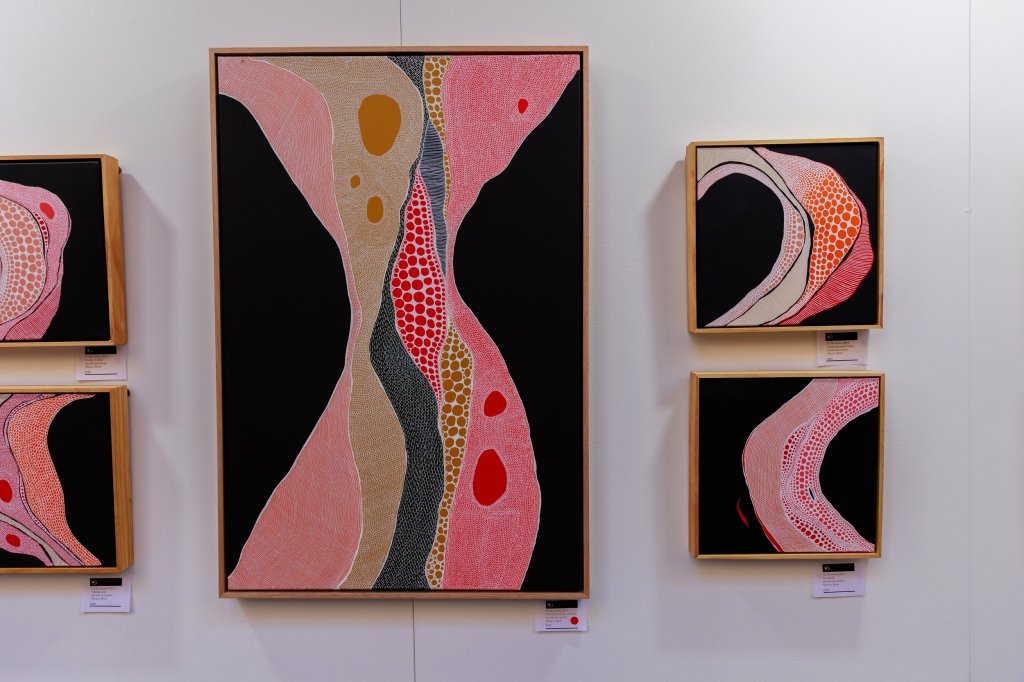
All aspects of Diana Costantini’s life are marked by creativity. Whether it’s heading a large team of multi-discipline creatives as creative director at the ABC, or experimenting with mixed-media in her spare time, the importance of art is an ever present reality for her.
All aspects of Diana Costantini’s life are marked by creativity. Whether it’s heading a large team of multi-discipline creatives as creative director at the ABC, or experimenting with mixed-media in her spare time, the importance of art is an ever present reality for her. While she also delves into watercolour, ink, collage and ceramics, her current collection, ‘Flow’, harnesses acrylic on canvas to celebrate the beauty of the female form through organic shapes, delicate mark-making and an earthly palette. Despite her success, the pressure to create – and create well – is a challenge Diana still finds herself adapting to as she learns more about her work, her process, and her capabilities. However, for Diana, like many other artists, the challenge is worth it. As we sit in a corner of the Cutaway in Barangaroo, sandstone and concrete encasing crowds of Other Art Fair attendees, we discuss why she needs art, why the world needs art, and why personal style is essential to hold on to as an emerging artist.
__________________
For those who don’t know, tell me about yourself and your relationship with art.
My name is Diana Constantini and I’m a multimedia artist living on Gadigal land, Sydney. I’m a creative director at the ABC, so I have a large team of mixed creatives that I lead such as animators, digital artists, producers, writers and design teams. This allows me to be creative at work, but also equally inspires me personally as I experience creativity outside of work. I like to draw from all of these places, rather than stick to one medium. I play with collage and ceramics, and although I’d like to master a few of them a bit more, I have been privileged enough to be able to immerse myself in creativity early in my life and my career.
My relationship with art is really just centred on my love to create. I always encourage my staff and creative team to do that as well. Yes, we do this for a living, but we’re also following a brief. So, I encourage them to try and create outside of the workplace because that’s where you can actually, really explore your own creativity. I just really love it.
Tell me about your current collection, ‘Flow’. What inspired it?
It’s inspired by the female form in a lot of ways. It’s all based loosely on the organic shapes and flows, and just the lumps and bumps that we have as women. It’s very shapely. There are no hard edges or hard lines. It’s very organic and quite feminine.
What is your creative process like, both generally and for this selection of work specifically?
I don’t try and overthink it to be honest. I just let it happen. I don’t even sketch it out in the formal sense. Instead, I often hand draw certain shapes and ideas pattern-wise and find myself doodling (for want of a better word) because I like mark-making. So, in this part of the process, I am trying to explore different shapes and find the right marks so that when I hit the canvas, I can just let it all happen and not overthink it. I also use a lot of blacks to give me that relief from the patterns which creates a lot of zen space in my work. Sometimes patterns don’t work and they clash, so I find standing back and viewing the composition as a whole really helps. That’s when I can really see the different styles working well together and creating something I love.
Do you find that creating art can be a therapeutic process for you?
Usually it is, however, when it comes to preparing for a fair like this, it can sometimes get to the point where it feels more like another job. Saying this, I have loved being disciplined with a specific series of works and seeing what I could achieve. Although, after this, I’m planning on taking a breather and getting back into art for other reasons; for the release outside of my day job and for the enjoyment.
Why do you believe art is so important?
The world needs art so much. It not only gives you a different perspective, but also allows people to channel the creativity and beauty that I believe everyone has in them, whether it’s music, cooking, whatever your thing is.
What do you find most inspiring about the artist community?
As an emerging artist myself, having a lot of artists as friends is such an incredible inspiration. Even here at the fair, there are so many beautiful artists that I’ve been surrounded by, so it has been really great to connect with everyone. Also, as someone who likes to find inspiration in a diversity of mediums spanning from graphic design to typography, developing a network of artists around me is a beautiful thing.
As someone working a full-time job and creating art outside of this, what advice would you give to emerging artists or creatives who are tackling a similar lifestyle?
I guess my advice would be to not close yourself off. Be open to all forms of influence. I think if you’re young and you’re trying to break into the workforce, just make sure that your folio of work still shows your own personal style. A diversity of style is a really important aspect for someone who’s employing creatives, as I do. An artists’ personal style and their ability to follow a brief in a creative sense are two very distinct things, so I would stay open and not shut down any opportunity.
To view more of Diana’s work, get in touch with her below:
Instagram: @loveartaus
Etsy: Loveartau
##

Can you commercialise chaos?
By Freja Newman
21 Nov, 2021
Freja Newman wonders whether anything good can come out of the commercialisation of Punk.
In Disney’s recent ‘Cruella’, audiences witness a story of fashion rebellion situated within the raucous London backdrop of the 1970s punk movement. And yet, the politicised aims of punk culture are washed out or even eliminated amidst a choreographed display of independence and eccentricity.
The film delves into the relationships and tragedies that transformed young Cruella, or rather Estella, into the notoriously villainous and glamourous Cruella De Vil (played by Emma Stone) we all know and fear. The film draws on Punk aesthetics as core to Cruella’s personality, showcased at its height as the villainess crashes a high end fashion show clinging to the side of a garbage truck. By dressing Cruella in a 40-foot-train dress crafted from newspaper clippings and other old, ‘trashed’ designs, Disney capitalises on the recyclability that dominates the punk style.
However, Punk is more than just a fashion movement and more than a trend in a Disney film. The punk movement was always inherently political, taking a stance against the mainstream through the promotion of an anarchic, anti-fashion, urban youth culture. By epitomising a D.I.Y attitude to fashion, punk style opposes the consumerism of 1970s postmodernism, objecting to traditional notions of family, status and gender. This mis-matched, recycled and often extreme style symbolised the testing of social boundaries: a rebellion against ‘the man’ in a society where the marginalised still struggled to have their voices heard.
Vivienne Westwood, a British punk designer coined as the ‘mother of punk’, was key to transporting this street movement into the design industry. Westwood and Malcolm McLaren opened the punk clothing store, ‘SEX’ and an innovative yet more expensive version of punk fashion emerged.
Although many praised Westwood for her so-called genesis of punk fashion, the struggle that underpinned the punk movement was forgotten and the commercialisation of punk culture began. As Westwood and other designers such as Jean-Paul Gaultier and Alexander McQueen adopted elements of the punk genre, the street style was transported into haute couture. As a result, those that were previously involved in this D.I.Y movement became marginalised, no longer able to afford this alternative aesthetic.
Punk was transformed into a symbol of wealth, rather than rebellion.
This commercialisation is epitomised by Disney’s Cruella. Cruella is rebellious, wearing Punk-esque subversive designs and adopting unapologetic behaviour. But ultimately, the fact that Disney – a major media company reliant on capitalism – profits off this fashion style is contradictory to the punk movement itself.
Whilst the irony is obvious, the disruption of trends and political dialogues through fashion continues. Alternative designers have maintained the mimetic pulse of punk, harnessing their authority and, albeit commercialised, platforms in the industry to mirror societal discourse and advocate for political change.
Major fashion brands and high-end labels can have a positive impact too, of course. By popularising skirts for boys, Gaultier harnessed punk to subvert gender norms. McQueen used fashion to destabilise lingering taboos of disability in the industry as amputee model, Aimee Mullins, walked his spring/summer 1999 runway on carved wooden legs. Westwood especially channelled her creative platform for political agendas by countlessly transforming her catwalks into protest marches for environmental and human rights issues.
This rebelliousness continues today, symbolised through a new class of elevated streetwear, relaxed shapes and trends of recyclability which have only grown amidst a social context of protests and political unrest. Designers such as Pyer Moss, Christian Siriano, Jeremy Scott and Prabal Gurung have dressed their runway models in graphic tees addressing issues from New York’s governor race to the over-policing of African American citizens. Just last month, in a Louis Vuitton Paris Fashion Week runway show, a woman crashed the runway in protest, criticising the ongoing environmental consequences of overconsumption in the fashion industry.
Cruella similarly defies the societal expectations forced upon her since she was young. In the first two minutes of the film, Stone narrates Estella’s countless fights and uniform violations that ultimately led to her primary school expulsion.
“It wasn’t [my mum] I was challenging, it was the world…how does the saying go? I am Woman, hear me roar. Well that wasn’t much of a thing back in 1964, but it was about to be.”
Yet whilst this new post-punk era, including fashion trends and Disney films, purports to reject the system, it remains a diluted definition of punk as a political phenomenon. While Cruella broadly contradicts punk’s anti-consumerist philosophy, it does so through the post-punk attitude of self-expression, rather than through collectivism or serious political claims. Punk culture would also caution audiences against the legitimacy of this growing trend of fashion activism, arguing that brands, especially those who have never been openly political before, are merely parading political messages to appeal to a new generation of buyers. The post-punk movement’s reliance on self-expression and individualism neglects the true spirit of punk and its united origins.
While this new era of punk has broadened the audience of punk, this protest has only revealed the urgent need to remember the politicised history of punk culture as a fashion genre with serious social objectives. Yes, films and movements like Cruella provide greater visibility on the values of activism and self-expression. Yet, their profitization of this subversive culture only serves to conceal the laboured reality behind the punk movement.
The rapid commercialisation of the chaos of alternative culture has softened punk sensibility. Although, one hopes that as long as fashion continues to respond or transform social discussions through shifting trends, remnants of the subversive punk culture will remain.
##
 Freja Newman